



Hydraulic vs. Air Over Oil vs. Battery vs. Electric Hydraulic Lifts: Which Is Right for You?
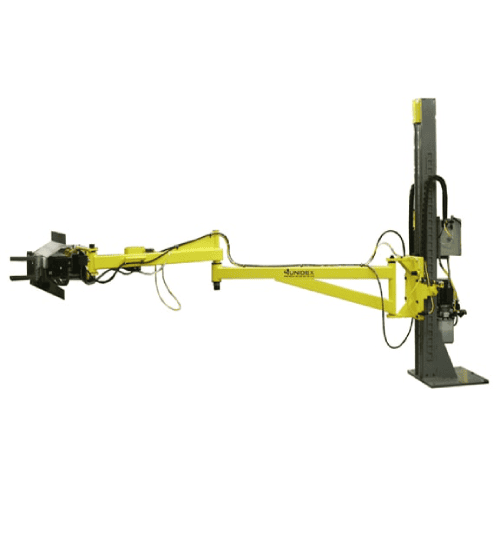
The right ergonomic lifting system can handle specialized tasks and materials to improve operational efficiency and reduce the risk of worker injuries. In contrast, choosing the wrong lifting equipment or a suboptimal installation can be more burdensome, disruptive, and expensive than helpful. So it’s important to understand the available options and make an informed choice for your application.
Unidex provides a range of lifting equipment for material handling, work positioning, and static or mobile needs. Our team brings years of experience working with many types of facilities and lifting applications in order to customize our equipment to your goals and operations.
In this quick guide, we’ll look at one of the most important aspects of choosing the best lift for your needs: the mechanism that does the actual lifting, including hydraulic, electric hydraulic, or battery-operated lifts. Keep reading to learn how they work, pros and cons of each, and some of the common use case considerations for each type of lift.
How Each Lift Type Works
Technically just about any lift equipment can be used to assist with lifting or material handling operations; however, different lifting mechanisms may be more or less suited to a specific application.

Hydraulic Lifts
Here, pressurized hydraulic fluid sealed in a cylinder exerts force on an internal piston, which causes it to rise. This vertical force is used to lift and/or lower objects and platforms. This type of system requires an oil reservoir and pump to create adequate pressure. They are highly durable and can generate very high force. Unidex offers versatile hydraulic lifts with heavy-duty lift tables or dual column lifts to suit different tasks.

Air-Over-Oil Lifts
These lifts are a hybrid of hydraulic and pneumatic cylinders and incorporate both hydraulic pressure and compressed air to create lifting force. They have internal power supplies and operate more cleanly than hydraulics, but they generally can’t provide as much force. Air-over-oil lifts are best for ergonomic support in lightweight tasks. Air drive oil gives a solid lift with controlled speed, where straight air will be spongy and quick.

Battery-Operated Lifts
These lifts are mobile and cord-free, making them a useful choice for field operations, large facilities, or applications across different workstations. Unidex battery-operated lifts use sealed 12V batteries and hydraulic cylinders.

Electric Hydraulic Lifts
These lifts combine a hydraulic pump with an electric motor. This combination powers smooth, consistent, and easy-to-control motion. These lifts work best for tasks that need continual power access at a fixed workstation and a higher weight capacity.
Pros and Cons of Each Lift Type
| Lift Type | Pros | Cons |
| Hydraulic | High capacity, strong force, long lifespan, AC powered | Requires regular fluid maintenance, potential leaks, slower speeds |
| Air Over Oil | Clean operation, fewer leak risks, no electric power needed, but needs available shop air | Less powerful, lower capacity, dependent on air availability |
| Battery-Operated | Fully mobile, no cords, ideal for portable needs | Limited battery life, not ideal for high-cycle operations |
| Electric Hydraulic | Smooth, consistent lifting with precise control | Requires outlet or power source |
Hydraulic cylinders offer high-force for powerful, reliable lifting, though they may require regular maintenance to check for leaks and connections. Air-over-oil systems are cleaner and simpler, but they can’t generate as much force. Battery-operated units are uniquely suited to mobile use cases, but they can’t power continuous operations because the batteries need to recharge. Electric hydraulic systems offer considerable control and power, but they need to stay close to an external power source.
Best Use Cases for Each Lift Mechanism by Industry
Lifts are not one-size-fits-all equipment, and different lift types work best for different applications. Below are some common uses for the types of lifting mechanisms covered here.
Hydraulic
Best for:
 Aerospace.
 Automotive.
 High-capacity lifting in manufacturing and assembly.
Air-Over-Oil
Best for:
 Chemical industries.
 Packaging.
 Explosion proof areas.
 Food or washdown areas
 Battery-Operated
Best for:
 Textile.
 Warehouses.
 Pharmaceutical.
 Mobile work stations or centers.
 Wherever power sources are not available and power cords are not practical.
Electric Hydraulic
Best for:
 Heavy equipment manufacturing.
 Laboratories.
 Aerospace.Fixed assembly stations for consistent productivity.
Choosing the Right Lift for Your Application
Here are some of the top considerations when selecting the best lift for your application:
- Power source. Will the unit be located with easy access to electricity or compressed air?
- Mobility. Will the units need to move frequently around the facility or are they used in a single location only?
- Capacity. What is the maximum load the lift will need to handle? What degree of lift and dexterity do you need? What are the dimensions of the objects being lifted?
- Space. How much floor space is available? Is overhead installation an option?
- Specialization. Will the lift need any specific compliance or certification?
The team at Unidex can help you determine the answers to these questions and develop a customized system that fits your requirements and operations.
Get Expert Guidance and a Tailored Lifting Solution
Unidex specializes in providing the right lift technology for each of our customers’ applications. Whether you need portable lifting power, heavy-duty material handling, or continuous lifting tasks to stay on schedule, our solutions are built to meet those needs. Contact us today to tell us what kind of lift you’re looking for and to start developing a custom lift solution.
Contact Unidex for a Custom Lift Solution
